
Homeschool entrepreneurship curriculum · Ages 8–14
Your kid doesn't read about business. They start one.
An eight-lesson course that leaves your student ready to sell a real product to a real customer — and count back the change. Written for co-ops, works at the kitchen table.
Instant PDF download. Teacher Guide plus one student workbook.
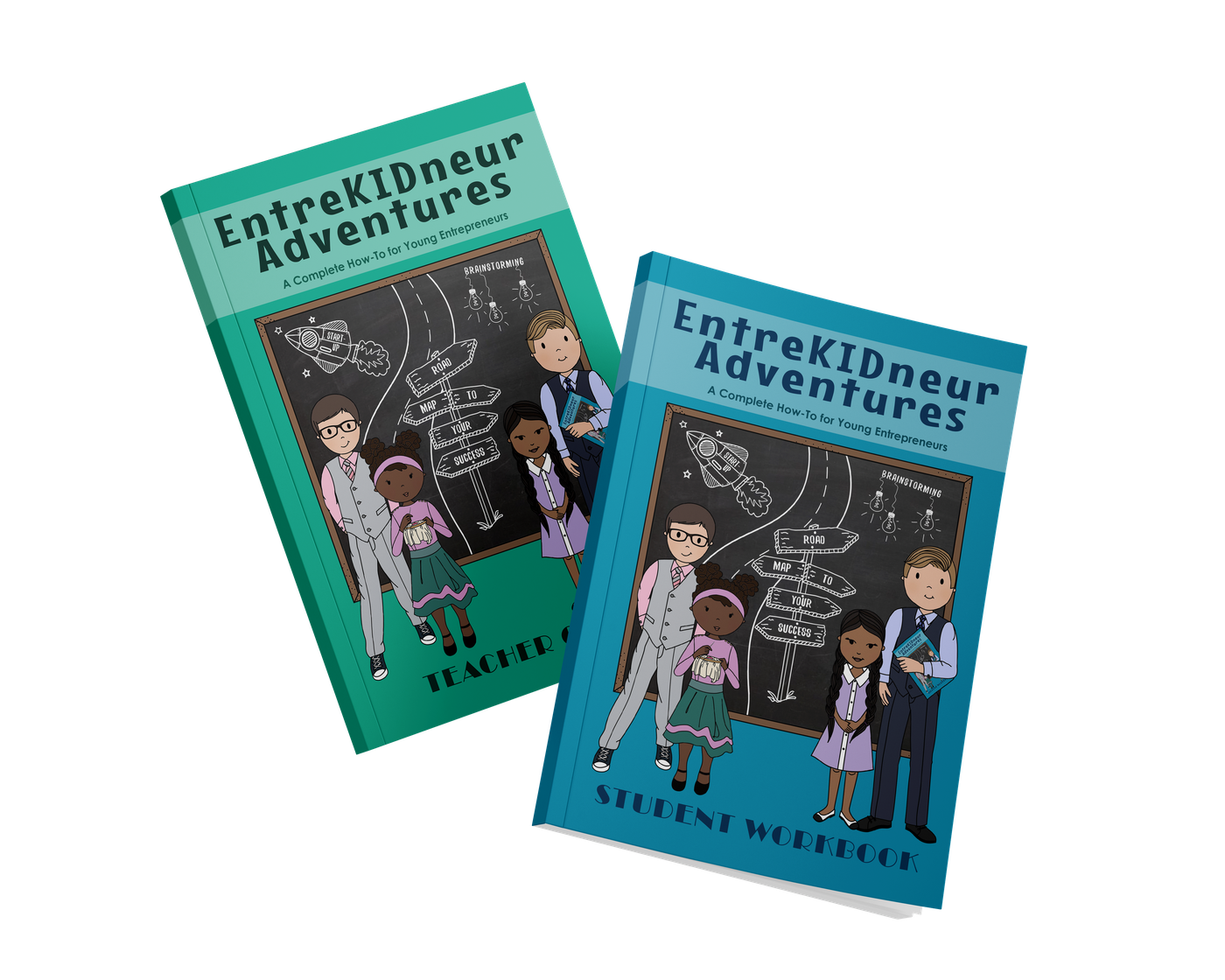
Every page made by hand. Every illustration drawn by an artist.
- 8 lessonsAbout two hours each — go weekly or split them
- Ages 8–14Upper elementary and middle school
- Co-op or familyBuilt for groups, works for one child
- Ready for market dayReal customers, real money, theirs to keep
A note from the two of us
Dear fellow homeschool parent,
In late 2019 Melanie was asked to teach an entrepreneurship class at our local co-op, and she pulled Justin in. He has a business degree from Sam Houston and works for a company that specializes in small businesses; Melanie has spent years on small start-ups and on teaching kids to turn what they love into something that earns. So we went looking for a curriculum.
What we found was decent and informative, and all of it was built on theory rather than application. Kids read about business, reflected on it, and filled in notebooks. Nobody made anything, and nobody sold anything.
Then 2020 happened... the co-op cancelled the year, and we used the time to write the thing we couldn't find. We've started businesses that succeeded and businesses that flopped, and we learned a lot from every one of them. Our own twins, Jaiden and Jace, started their first businesses at seven and were selling at local markets not long after. So we wrote down what had actually worked.
That's why everything in these books points at a real market day. When a kid has looked a stranger in the eye, explained their product, made the sale, and counted back the change correctly, that's an accomplishment that can't be bought. It has to be earned. We've watched it change ten-year-olds.
One more thing we're proud of: the illustrations came from two teen artists, Macey and Sarah Jean, who were paid for their work. It seemed like the right way to make a book about kids earning their own money.
Blessings,Melanie & Justin VitovskyA homeschool family of four, in Texas

Most entrepreneurship curricula teach kids about business. This one puts them in one.
A reading unit
Students learn what entrepreneurship is. They answer questions, reflect, and move on to the next subject.
vs.
EntreKIDneur Adventures
Students pick an idea, test it, price it, name it, brand it, build it, and sell it to strangers who pay with real money. The money is theirs to keep.
How the eight lessons run
From "I don't know what I'd sell" to a booth with their name on it.
Eight lessons of about two hours each. Teach one a week and it moves quickly; split the longer ones across two sessions and it stretches to a full semester. The lessons set the pace, not the calendar.
- Where money comes from. How people earn, how a job does it, and what entrepreneurship is — connected to making money rather than defined in the abstract.
- Why anyone starts a business. Why people become entrepreneurs and the ways they do it, the real advantages and disadvantages, and the first pass at their own business ideas.
- What your business needs. Supplies, money, a partner — students work out what it actually takes, then share their idea and answer questions about it out loud.
- Prototypes and honest feedback. Students present what they've made and learn to give feedback without criticism and receive it without flinching. Branding enters the picture.
- The business plan. Why a plan matters, what advertising is for, and writing an elevator speech that explains the business to someone who's never heard of it.
- Selling like a professional. Presentation skills, plus the sales etiquette most adults were never taught: manners, introductions, greetings, how to speak to a customer.
- Counting back change. A genuinely effective method for counting back change during a transaction, more etiquette practice, and building real inventory.
- Setting up the table. How a display makes products more attractive, feedback on each student's setup, and signing up for actual market events.
Then: market day. By the end of Lesson 8 students are ready to sell — all that's left is building inventory and advertising their event.
Not only did they come away with actually creating their own businesses and making their own money, they gained so much confidence in themselves along the way. This curriculum is great for families and co-ops.
Tiffany Day Homeschool mom, Cypress, Texas
Straight out of the books
Have a look inside.
Eight real pages. The Teacher Guide tells you what to say, what to ask, and what your students will probably say back. The Student Workbook is where they do the work. Pick a page to read it.
Click the page to see it full size.
What you get
One guide. One workbook per student.
The Teacher Guide is reusable — you'll teach from the same copy for years. The Student Workbook is consumable, so each student needs their own.
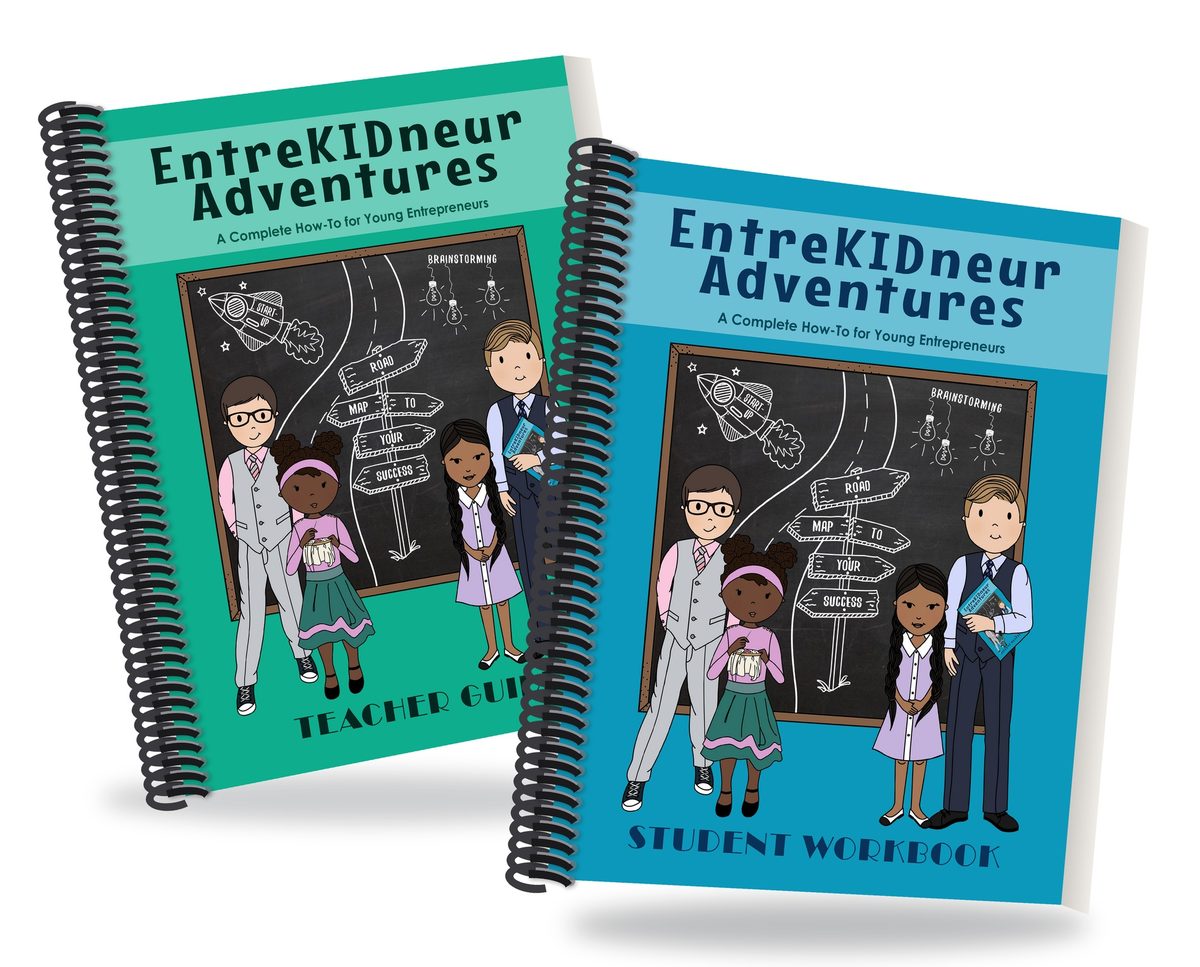
Complete Teacher Bundle
Digital download
- Teacher Guide — 192 pages, full color
- One Student Workbook — 172 pages
- Print for every kid in your family, forever
- Everything you need for all eight lessons
Additional Student Workbook
Per student, digital
- One more student license
- For co-ops and larger groups
- Add one for each student outside your family
- Already own the Guide? This is all you need
One family at home: $78, however many kids you have.
A co-op of ten: $78 + nine licenses for students outside your family = $348.
Teaching it again next year? You already own the Guide. Just add workbooks for the new group.
For the person teaching it
You don't need a business background.
Every lesson tells you what to say, what to ask, what your students will probably answer, and what to do next. Nothing assumes you've run a company.
The sticky notes in the margins are the things we told ourselves while we taught it — the real ones, from our very first draft, permanently added to yours. Use them, ignore them, make it work for you.
Built for co-ops and group classes, but families use it at the kitchen table and it works. Older students can go deeper into the business plan; younger ones can skip whole sections and still get everything that matters.
Let them own their ideas. A small, safe failure at ten is worth a lot.
Expect the mess. Glue on the table means it's working.
Someone will change their whole business in Lesson 6. That's fine.
From families in our first co-op cohorts
What parents told us
My 3 children (ages 9, 11, and 13) used the EntreKIDneur curriculum and loved it. Written for ages as young as 8, each one of my kids was able to easily grasp the concepts of entrepreneurship through the well-focused format and digestible approach of the curriculum. Even I was able to take away very useful information!
Rachel Beard
They went from having zero knowledge about business to starting their own business from the ground up and running it successfully! Their hard work and commitment has inspired their baby brother to start a business too, like his older sisters!
Lukisha Willett
My son learned how to approach a business idea and strategically and persistently attack it step by step. Nothing was left up to guess work.
Katlynn Lanham
The classes were engaging, the book has a great design, the illustrations capture the kids' attention. Some of the principles my son learned are: counting money, pay and give change. Speak in public. Supply and demand. Cost: profit and loss, how to price a product. Designing his own brand, motto, etc.
Nohemi Passey
One of my favorite parts was seeing all the kids selling their products at a market.
Bobbi Jo Dawson
Questions
Questions we get asked
What ages is this for?
Written for upper elementary and middle school. Parents have used it successfully with children as young as eight, and older students can go deeper into the business plan sections. Mixed-age groups work well — that's what it was built for.
Can I use this with just one child at home?
Yes. It was designed for a co-op or group class, but families run it at the kitchen table and it works. The bundle includes one student workbook, so a single-student household needs nothing else.
I have three kids. What do I buy?
Just the $78 bundle. One purchase covers your family — print a workbook for each of your own children, this year and for younger siblings later. The additional licenses are for students who aren't yours.
Does one bundle cover my whole family?
Yes. Buy it once and every one of your own children can work through it, including the ones who aren't old enough yet. What it doesn't cover is other families — if you're teaching a co-op or a group of friends, each student outside your household needs their own workbook license.
Can I print the workbooks myself?
The bundle includes the right to print for your own household as many times as you need — including for younger siblings in future years. That right doesn't extend to co-ops or groups, where each student outside your household needs their own license.
The books in the photos are coil bound. Is that what I get?
Those are our own copies, printed and bound so they'd survive a year of class. What you're buying is the PDF — the Teacher Guide and the Student Workbook, ready to print at home or wherever you print. We don't sell printed copies yet — we're working through printers and binding options now, and we plan to offer them once we're happy with the result.
If you want yours to look like ours, any copy shop will coil bind a stack of pages for a few dollars, and online printing services will print and bind the whole thing and mail it to you. A three-ring binder works just as well, and it lets you pull out the pages your students are working on.
Do I have to organize the market day?
Yes, and it's more flexible than it sounds. A co-op event, a holiday bazaar, a church hall, or a booth at a local farmers' market all work. Many organizers offer young sellers a discount when you ask.
How long does the course take?
Each lesson runs about two hours, plus work students do between sessions. One lesson a week moves at a good clip; splitting the longer lessons across two sessions stretches it to a semester without losing anything.
Say your ideas out loud, believe in yourself, and trust the process.
That's what we tell the kids. It works on parents too.
Instant download. Start whenever you're ready — and go build something.